Posts

Showing posts with the label wounding

Conflict: other ways to get hurt

Image
No game is complete without falling damage rules. And there are, of course, many other ways to get badly hurt, such as vehicle collision, suffocation, drowning, electrocution, flammable liquids, poison and disease. Cold, heat, thirst and hunger are also relevant, especially in a game of modern warfare, but we'll leave those till later and deal with immediate violence both accidental and deliberate. These are abstracted with the wounding system, using the hit locations and wound effects .  Falling  causes one blunt  wound to a random location for each 3m fallen onto a medium-hard surface like grass. This may be protected against with body armour, with the falling injury using the "frag" category. A hard  surface like concrete or metal adds a wound. A soft  surface like a mattress subtracts a wound, as does being drunk.  The Athletics expertise has a familiarity breakfall , which automatically turns the first wound from falling onto the back - this always co...

Conflict: Readiness

Image
This article on overcoming the friction of combat, along with the same authour's article on wounding, got me thinking on the ideas which now form Conflict. For those who have not experienced a life-threatening conflict or extreme trauma situation, here is an experiment on feeling adrenaline.  go for a hard  run, flat-out for two minutes - use the timer on your phone. Look before you cross the road, and look at the street signs.  when you feel you can no longer go on, set the timer for another two minutes, and go flat out again .  now stop, and get out your phone, and without looking up for any signs, use it to write down the name of the street you just passed. Try.  place thumb and forefinger against each-other, and rub them together by your ear. See if you can hear them. Try. slap yourself on the thigh. Can you feel it? Try.  Most likely, you cannot remember the name of the street you just passed, your fine motor skills have degraded significantly, and yo...

Conflict: wound effects

Image
Following on from the previous article  on determining whether  the person is wounded, we now look at the effects  of the wounds; all of this is yet to be playtested and so is subject to change. The three wound categories are KIA, INC and WIA. The person may be left untreated, given first aid, or given proper care from a physician.  KIA means that the person is unconscious and on their way to death. Given successful first aid quickly enough, they will last those minutes, but die in hours instead. With successful physician treatment, they will recover to an INC condition. Absent treatment or failed care means death.  INC means they are incapacitated. In most cases they will also be unconscious, though some tougher individuals may be able to remain conscious or even active. Given first aid they can be kept stable for some hours, but will need to be cared for. Physician expertise can mean that in a week or two they can recover to merely WIA. Untreated or failed ca...

Conflict: Wounding

Image
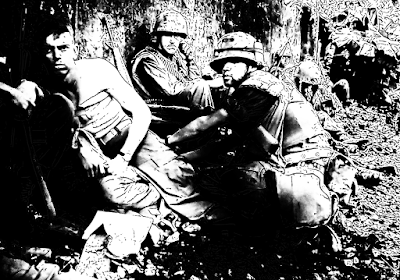
In Conflict: the adventure game of modern warfare  we have tried to establish a more-or-less realistic wounding system to cover modern combat. This was inspired by Charles Franklin's article Hitting Them Where It Hurts .  From Franklin, we learn that of those wounded, the wounds will break down as below. KIA being death, INC being incapacitated, and WIA being merely wounded. Note, this is not the results of every “hit”, but of wounds requiring treatment . It might be for example that there are actually proportionally more hits on the torso compared to the head, but that torso hits are less likely to require the attention of a medic. But in a tactical or roleplaying game, we are not interested in hits but hurts, what takes the person out of the fight permanently (KIA), temporarily (INC) or hinders them (WIA). Head 21%,  Torso   21%,  Limbs 58% No breakdown of limbs is given, we assume exactly half of wounds on each of arms and legs. Probably roughly even chance...